
Ancient Hydrothermal Systems Cause Volcanic Flank Collapse
The long-term hazards associated with large composite volcanoes are generally determined based on previous eruptive history or magma activity. However, a recent study by Kereszturi et al. (2026) proposes that significant risks may also arise from hidden processes deep within the volcano.
The new paper(external link) entitled ‘The role of fossil hydrothermal systems on volcanic flank collapses—Deciphering the volcanic history of Ruapehu, New Zealand’ provides a new way for geologists to understand catastrophic failures in active stratovolcanoes. The research team mapped out the old and weathered structural failures at Mount Ruapehu, the largest active volcano in New Zealand and found that hydrothermal alteration could be a key weakening agent.
Hydrothermal systems are common to many andesitic composite volcanoes. However, few studies have mapped the full extent of the historical development. As very acidic, boiling fluids circulate throughout the volcanic rock, the hard lava is chemically altered into soft and weak, clay, sulfide and sulfate rich rock. Over thousands of years this causes the rock to become increasingly weak, alter its permeability, as it literally cooks from the inside out.
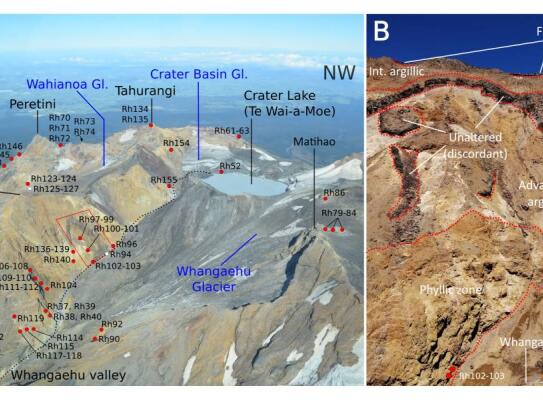
To understand how this weathering process has developed over time, the research team focused on the old (>80 ka) Wahianoa Formation at Ruapehu. Using detailed fieldwork techniques alongside advanced mineralogical, geochemical, and geophysical methods, the team mapped a complex fossil hydrothermal system and its evolution over time. This involved collecting data using Scanning Electron Microscopy (SEM-EDS) and Short-Wave Infrared (SWIR) Spectroscopy to investigate microscopic weathering and mineral alteration. X-ray analysis and X-ray Fluorescence (XRF) were used to identify different alteration mineralogy and profiles, while aeromagnetic surveys provided insights into subsurface structure.
The analysis revealed that the hydrothermal system had evolved into two different areas: Core Zones that contained a mixture of alunite, pyrite, silica polymorphs, kaolinite and smectite clays. and the Distal Zones containing goethite/hematite, clay minerals, and iron sulphates. The types of minerals and their distribute play an important role in determining the physical and mechanical properties of volcanic rocks.
This study demonstrates that hydrothermal alteration can exert long-lasting controls on volcanic hazards and act as a precondition on flank collapses. Geophysicists can use these findings to identify areas containing weak, unstable clay-rich rocks and determine which volcanic flanks may be most susceptible to large-scale collapse. This study suggests that hydrothermal alteration should be an integral component of comprehensive volcanic hazard assessments worldwide.
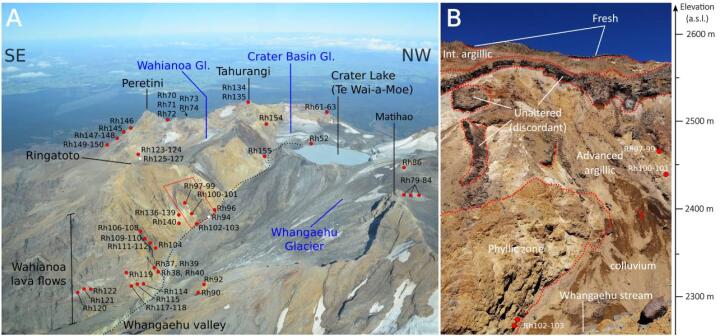
(B) Type locality of the vertically exposed Wahianoa Formation showing a transition from the phyllic (bottom units) to advanced argillic to intermediate argillic (middle) covered by unaltered young Whakapapa Formation deposits (top). The outcrop covers ∼350-m-thick successions of variously altered deposits.